The Economists lied
In concluding his seminal treatise on, “The General theory of Employment, Interest and Money,” John Marynard Keynes submitted that “—- the ideas of economists and political philosophers both when they are right and when they are wrong, are more powerful than is commonly understood. Indeed, the world is ruled by little less. Practical men, who believe themselves to be exempt from any intellectual influences are usually the slaves of some defunct economist.
Madmen in authority who hear voices in the air, are distilling their frenzy from some academic scribbler of a few years back. I am sure that the power of vested interests is vastly exaggerated compared to with the gradual encroachment of ideas. Not indeed, immediately but after a certain interval, for in the field of economic and political philosophy, there are not many who are influenced by new theories after they are twenty-five and thirty years of age, so that the ideas which civil servants and politicians and even agitators apply to current events are not likely to be the newest. But soon or late, it is ideas not vested interests which are dangerous for good or evil” Before May 29th, 2023, there were heated formal and informal debates about the trouble with the Nigerian economy. Many economists and policy analysts attributed the problem to the huge funds paid out as fuel subsidies and the multiple exchange rates which allocated the scarce foreign exchange in a non transparent manner, in some cases, to non-economic operators. These two policies turned a few privileged individuals and politicians with no visible economic activities to billionaires overnight. They believed that only the rich benefited from the fuel subsidy.
There was also the feeling that fuel was cheapest in Nigeria and that encouraged smuggling and black-market racketing in neighbouring countries which did not help the economy. The singsong was that the fuel subsidy drained the economy of the resources that would have been channeled to develop it and prosper the people. The belief was that the proceeds from the removal of fuel subsidy will be invested in infrastructure development, agriculture for food security, social welfare and human capital development such as healthcare, skill acquisitions, education as well as security of lives and properties.
The air was ridden with calls for the removal of the fuel subsidy. In that frenzy, everybody became an economist, analyzing, pontificating and recommending how our economy will become an Eldorado for everybody if fuel subsidy is removed and multi-exchange rate is harmonized. Many of these economists believe that all subsidies are inherently bad and unless the subsidies are removed, Nigeria will not have a robust economy. The voice of the pseudo-economists drowned that of the real economists. In our country, once a profession or calling becomes fashionable and trendy, everybody wants to be so addressed. Economics is an influential profession that gives one the leverage to express an opinion on the direction of the economy and social life. People want to be addressed as Economists. Our journalists who are supposed to know better, do not help matters, as they address every public opinion analyst as an Economist. Finally, the call for the removal of the fuel subsidy was answered by President Bola Ahmed Tinubu on 29th May, 2023 when in his inaugural address, he declared that, “Fuel Subsidy is gone”. The President later confessed that the transformative statement, “subsidy is gone” was not part of the original text of his inaugural address which he was reading. On his instinct, he extemporaneously declared it in the middle of his speech and it became a policy of his government. The implication is that his transition committee and his economic think-tank committee may not have evaluated it as a priority takeoff policy to include in the inaugural address. Probably, they deferred it for later appraisal and implementation. Where then did the President get the confidence to announce such a far-reaching policy. It must have been from the clarion calls for it by Economists, public policy analysts, pseudo-economists, multilateral
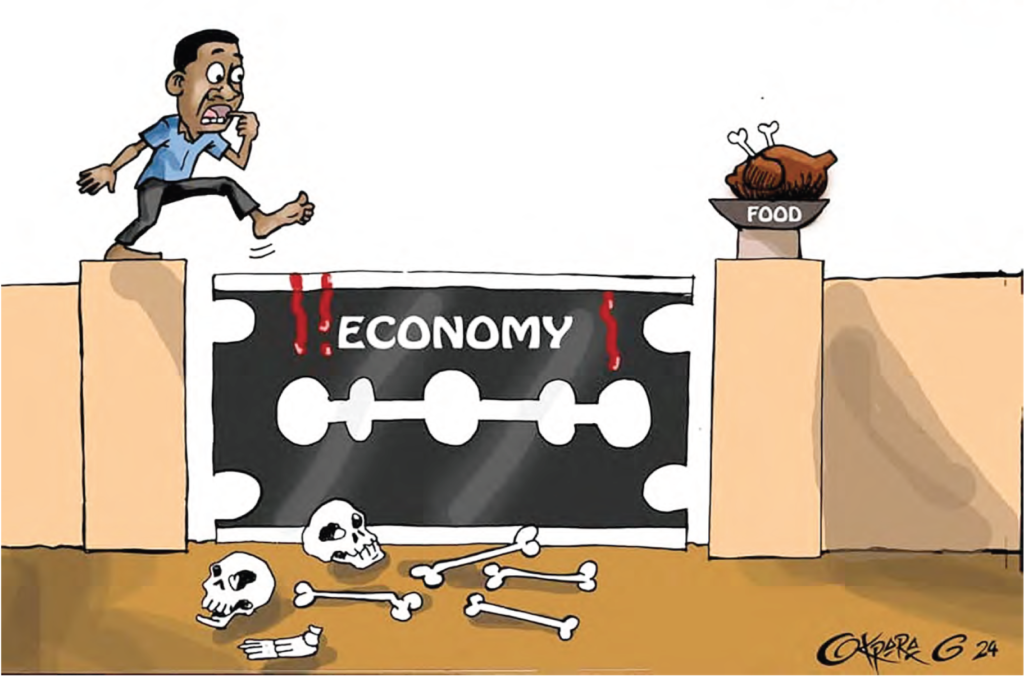
financial institutions, the work done by his transition team and the fact that the previous administration did not budget for the payment of subsidies beyond June, 2023. Even if the previous administration did not budget for fuel subsidies beyond June, 2023, the President on inauguration could have presented a supplementary budget for fuel subsidies. Before, May 29, 2023, fuel sold at N165 per litre. On the announcement of fuel subsidy removal and its implementation by NNPC, the fuel price shot up to N589 per litre. In November, 2025, fuel sold at N930. When the epic fury war between the United States and Israel on one side and Iran on the other side started on February, 28th 2026, the fuel price jumped to N1,300 per litre. On the Exchange rate harmonization policy, the Federal Government through the Central Bank of Nigeria merged the multiple exchange rates to align with the parallel market. This was done on June 14th, 2023. By June, 13th, 2023, the official rate was N471/$ and the parallel rate was N765/$ which gave a difference of N287/$. On the merger of the rates on June, 14th,2023, a devaluation of 31%occurred and the official rate moved to N620/$ and the parallel market was N765/$. By 15th June, 2023, the official rate graduated to N657/$ and the parallel inched to N791/$. Sometime in 2024, the rate went haywire as low as N1,900/$ until the CBN intervened by restructuring the foreign exchange market with forex reforms, cancelled the license of many bureau de change, commenced funding the market using the BDCs in the market. It is true that money has been saved by the removal of the fuel subsidy. The removal has boosted government finances. On the other hand, it has greatly impoverished Nigerians. The Federation Accounts Allocation Committee (FAAC) has shared more revenues to the States and Local Government Areas. In 2023, the FAAC allocation to States was N3.58trillion. This rose to N5.81Trilion in 2024 which amounted to 61.6% increase in revenue allocation to the States. In the first half of 2025, the States received N3.45trillion between January and June, 2025. When the 13% derivatives are added, the total allocation to States for the first half of 2025 amounted to N4.181trillion. If the Local Govt allocation of N2.504trillion is added, the total FAAC revenue inflow to the States governments amounted to N6.685Trillion. This amount exceeded the total receipts for 2023. The balloon inflows accrued from the savingsfrom the fuel subsidy, NNPC remittances to the Federal government which rose by 86% from N3.6trillion in 2023 to N6.7trillion in 2024. Equally the exchange reforms helped to increase the Naira denominated inflows to FAAC. A lot of revenue also came from taxes like Money transfer levy (EMTL). The State Governors and the subnational governments are the greatest beneficiaries of the removal of fuel subsidies, the harmonization of the exchange rates and other reform programmes. Most of the State governments have had their monthly FAAC allocations increased ten times yet the Governors have not been able to invest in projects that will transform the lives of people. Contrary to the expectations of the economists, many of the governors are not utilizing these increased revenues to embark on projects and activities that enhance the welfare, standard of living and prosperity of the people. A lot of the projects they execute are politically motivated. Some of the revenues are looted and are used to compensate political cronies. Poverty rather than receding is increasing. The State governments are a major stumbling block to the dividends of democracy trickling down to the poor of the poor. The World Bank stated that about 53Million people have gone into poverty since the reforms began. About 63% of Nigerians which accounts for a staggering 141million people live below poverty line. Unemployment is soaring providing a pool for insecurity. No new jobs are being created. It is about 17% workers that hold wage paying jobs. Our envisaged benefits of the multiplier effects of the removal of subsidies on the welfare, development and prosperity of the people have fallen flat on the altar of mis-governance in the states, local governments and even the Federal government. The Economists lied for us. The Economists and the policy analysts did not tell us that the fuel subsidy was riddled with corruption which ballooned its size thereby draining government finances and causing budget deficits. It took the former EFCC Chairman, Mr. Abdulrasheed Bawa to write a book titled “The Shadow of loot and losses: Uncovering Nigeria’s Petroleum Subsidy Fraud”. In the book, Mr. Bawa highlighted how billions of Naira were siphoned from public coffers through fraudulent subsidy claims which included overinvoicing, forged shipping documents, ghost importing and collaborations between corrupt government officials and private marketers and firms. He wrote that, “manipulations of bills of lading, by altering shipping documents, fraudsters exploited international price fluctuations to claim higher subsidies. Round tripping and double claims. Single shipments were often used to obtain multiple subsidy payment, diversion and smuggling, subsidized fuel was frequently diverted to black market and smuggled out of Nigeria for profit. According to Mr Bawa, Nigeria lost over $450Million to petroleum subsidy fraud between 2006 and 2012.Mr Bawa highlighted that “our investigations revealed that, as admitted by the oil marketing companies involved, fraud related to petroleum subsidies exceeded N68Billion which transalates to $450Million in direct fraudulent activities. This fraud involved 59 out of the 141companies that participated in the PSF Scheme from 2006 to 2011. We also uncovered fraudulent claims amounting to N19.6Billion on issues related to traders (Sellers) of which the oil marketing companies denied knowing anything about. However, by 2008, 2009, and 2010, we uncovered significant fraud totaling N11.5Billion, N4.88Billion, and N10.8Billion respectively. 2011 marked what I consider the peak period of petroleum subsidy fraud during which we identified activities amounting to N41.7Billion. Rather than dealing with the fraud associated with fuel subsidy, the government went the easy way by removing the fuel subsidy. In all these, our Economists are saying that the reforms are transforming the economy with resounding results. They refer to the data from the rating agencies, multilateral institutions and CBN. Inflation has gone down. The Exchange rate has stabilized. There is growth as GDP has gone up. The reserves are up. Investor confidence has increased. While the data is looking up, the real life is depreciating down wards. This exemplifies one of the riddles of Economics; while the macroeconomic factors are looking up, the microeconomic agents/ units like the individuals, households and firms are suffering. Our economists gathered on 26th March, 2026 at CBN Monetary Policy Forum in Abuja to celebrate these milestones. But nobody reminded the CBN that it is in dereliction or neglecting its responsibility of development financing, an aspect of its functions that impacts on the economy of individuals, households and firms. Development Financing, if transparently executed is a catalytic function that drives poverty reduction. Our Development Finance Institutions are not doing enough to tackle the ravaging poverty in our land. The Epic fury war by United States and Israel on Iran has resuscitated the over-riding need for safety nets and social security in Nigeria. We live in a world that is constantly susceptible to upheavals, crisis and instability. The two major products that take a hit of volatility in crisis times are commodities especially oil/gas and currencies. The Nigerian economy runs on oil & gas and is equally tied to the aprons of dollars because of our high import dependence. The fuel subsidy is gone, electricity subsidy is gone. The housing deficits are excruciating and the rents are skyrocketing. The governments both at the Federal and State are not showing interest in alleviating the housing deficits. They are rather compounding the problem. In the biggest Federal housing estate in Abuja, what it takes to obtain a building plan approval is enough to complete the building. The government appointed Chief Executive of the Housing Authority uses mental calculation and perception to compute the cost of building plan approval. He has dispensed with the official metrics for plan approval. Politicians are killing us. Fuel price is hitting the roof. House rent is up, electricity rates have gone up. The middle class that used to be the anchor of the poor are gasping for breath and completely wiped out. They manage to fuel their car, fuel generator, pay rents or maintain existing house, pay school fees, feed dependents and the income is depleted. There is hardly any savings. Without savings, there will be no investments and without investments, developments is impaired. What is more, Poverty continues to ravage. Nigeria is the most populous country in Africa. Sudan is ridden in war. America and Europe are removing aids and embarking on Nationalist policies, how can Africa be rescued. Our Economists are acquiesced and have continued to serve the status quo. Everybody wants to be politically correct and aligned protecting our entrenched interests and comfort zones. In Gambling on Development, Prof Stefan Dercon, talked about the elite compromise as the impediment for development. Who will speak for us. In times gone by, Prof Sam Aluko would have warned of the dangers of removal of the safety nets such as subsidies as even the developed nations have subsidies. Dr. Pius Okigbo would have told them that targeted subsidies can support social stability and economic competitiveness. Prof Ojetunji Aboyade would spoken for us. Prof Eskor Toyo would have spoken about ballooning debts traps. Dr Ibrahim Ayagi would reminded them of the consequences of macroeconomic stability without welfare nets. Nigeria is the only oil producing country that has not done anything to alleviate the sufferings of its citizens during this excruciating energy crisis engendered by the Epic fury war.
Dr Allwell Umunnaehila is a Chartered Stockbroker, a Financial, Economic and Management Consultant who holds a Ph.D in Business Administration from Babcock University,Nigeria. He is the CEO, AllwellBrown Consulting Ltd, an author, a seasoned scholar and Investment trainer. He is also a Fellow of Chartered Institute of Stockbrokers (CIS), Member, Chartered Institute of Securities and Investment (CISI), Member, Capital Market Academics (CMA) and a licensed Securities Dealer with Securities and Exchange Commission, Nigeria. He can be reached on aumunnaehila@allwellbrownconsulting.com.